Professional meat grinders are among the essential production equipment for butchers, meat processing companies, and, more generally, food processing applications, as they allow for the production of minced meat in large volumes, ensuring consistent quality standards. In large butcher shops, meat grinders can be used to prepare burgers, meatballs and fresh sausages, while in kitchens serving mass catering - such as company canteens, catering, and schools –, they allow for large-scale preparation while maintaining complete control over the quality and freshness of the raw materials. The ability to grind meat on the spot, starting from selected cuts, allows industry players to offer better products than already ground meat of industrial origin, ensuring complete traceability, product freshness, and food safety for end consumers.
The choice of a meat grinder for butcher shops or for the food industry must consider several factors that determine the machine's suitability for specific operational needs, such as production capacity, which must be proportionate to the daily volumes to be processed, construction materials (which influence durability and hygiene), and the presence or absence of refrigeration systems. For this reason, it is essential to carefully analyze the technical characteristics, evaluate your production needs and understand which elements distinguish the best models.
In this short guide, we will analyze the essential aspects that characterize a quality commercial meat grinder and all the factors to take into account to identify the most suitable machine for each operational need.
The choice of a commercial meat grinder must start from an accurate analysis of the production needs and characteristics of your business. In fact, each business presents specific needs that determine the technical characteristics required of the machine: a small artisanal butcher's shop operates with completely different logic than an industrial laboratory that supplies large-scale retail chains or a kitchen for collective catering that has to prepare hundreds of meals a day.
One of the first elements to be evaluated are expected production volumes. To choose the right machine, it is important to precisely define how many kilos of minced meat must be produced daily and weekly, also considering any seasonal peaks. This estimate will determine the most suitable type of machine - for example, more compact solutions for low volumes or industrial meat grinders for intensive production.
The type of products you intend to process is also a determining factor in your choice. Butchers that limit themselves to producing minced meat for burgers or meatballs will have different needs than companies that produce fresh sausages or products with special grind sizes. Different applications may require specific machine configurations and also influence technical choices, which will be explored in more detail in the following paragraphs.
Production capacity is one of the first characteristics to be evaluated when choosing a commercial meat grinder because it determines the amount of meat the machine is able to process within an hour, and varies considerably based on operational needs. Typically, professional meat grinders can work from a minimum of 200 kg/hour for small businesses up to over 1,500 kg/hour for industrial operations and large-scale retail trade.
Engine power represents the element that directly influences production capacity: professional machines generally have engines with power outputs between 0.7 and 5.0 kW. For artisanal butchers and medium-sized workshops, a 1000-1500 Watt engine is usually adequate, while for large-scale operations and intensive production solutions with power outputs above 2000 Watt are recommended.
A powerful motor not only guarantees reduced processing times but also allows for the processing of more fibrous meats and less tender cuts without compromising the quality of the final mince. This aspect is particularly relevant when working with meats that have nerves or connective tissue, situations in which an undersized motor could cause overheating and compromise the integrity of the machine. Higher power output also helps with very cold or partially frozen meats.
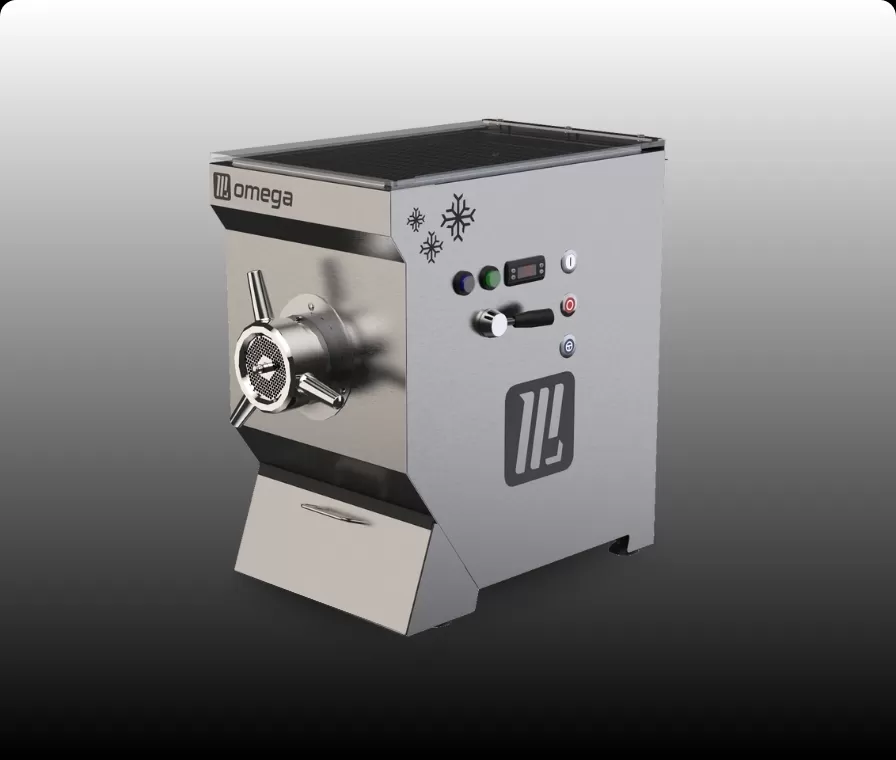
Refrigeration technology is one of the most relevant aspects in choosing a meat grinder machine. Refrigerated meat grinders are distinguished from traditional models by the presence of an integrated cooling system that maintains the optimal temperature throughout the entire grinding process.
The main advantage of a refrigerated meat grinder is the maintenance of the cold chain during processing. Unlike traditional models, refrigerated systems allow the minced meat to be processed and stored at controlled temperatures, generally between 0°C and 4°C.
The use of a refrigerated meat grinder has significant health and hygiene benefits. Containment of the bacterial load is a key aspect, especially for operators in the large-scale retail sector and butchers who must ensure high standards of food safety. The cold prevents the microbial proliferation that normally occurs when minced meat experiences temperature increases, allowing the end customer to be offered a safer product with a prolonged shelf life.
Cold grinding also allows the organoleptic properties of the processed product to be preserved, avoiding the rapid deterioration of the meat that characterizes traditional processing processes. A particularly relevant aspect concerns the preservation of unsaturated fatty acids naturally present in meat, which during grinding tend to be distributed in the liquid produced during the processing phase. Refrigerated meat grinders, on the other hand, allow all the characteristics and original properties of the meat to remain unchanged, ensuring a final product of superior quality, both from an organoleptic and nutritional point of view.
Another operational advantage of refrigerated meat grinders concerns management flexibility. These machines can in fact remain inactive even for prolonged periods throughout the day, storing already processed minced meat inside the machine without any loss of quality. This feature is particularly advantageous for butchers, where the ability to immediately serve customers without having to repeat the entire preparation procedure can represent a significant competitive advantage. Using a traditional meat grinder, any pauses in processing would require the machine to be completely emptied and the product immediately refrigerated, resulting in a disruption of the operating flow.
The most advanced configurations allow you to select different levels of refrigeration based on the type of processing and the ambient temperature, proving particularly advantageous in summer periods or in particularly hot places.
The choice of construction materials significantly affects the durability, hygiene, and ease of maintenance of a professional meat grinder. Stainless steel represents the reference standard for higher quality machines, ensuring corrosion resistance, ease of cleaning and compliance with the most stringent sanitation standards.
Components that come directly into contact with food must be made of AISI 304 stainless steel or higher. This material offers excellent mechanical resistance properties and can be subjected to even aggressive washing cycles without undergoing alterations. The hopper and grinding assembly must be easily disassembled to ensure thorough cleaning. The best professional meat grinders are designed following rigorous quality and hygiene standards, with joints and surfaces designed to prevent the accumulation of organic residues.
The cutting system of the meat grinder is an important technical element, which determines the quality and grain size of the final minced meat. The grinding systems that characterize professional meat grinders are mainly two: the Enterprise system and the Unger system.
The Enterprise system represents the most widespread and commonly used solution in small and medium-sized professional machines. It consists of an auger, a four-blade rotating knife and a perforated plate that determines the final size of the ground product. Meat is minced in a single step, offering rapid and adequate results for most applications. This configuration is particularly effective for lean meats and produces a medium-grain mince, ideal for burgers, ragù and traditional preparations.
Instead, the Unger system involves progressive grinding through the use of knives and multiple plates. The meat undergoes two or more successive cutting stages, resulting in a much finer and more homogeneous final product. This system is particularly suitable for fibrous meats, with a high presence of connective tissue or fats and can also be used for cutting frozen pieces, as, having multiple cutting steps, it allows the mincer to be kept from straining.
The grinding head diameter is a parameter that significantly influences the productivity of the machine. The most common mouths have diameters between 82 mm and 130 mm: the smaller diameters (82-98 mm) are adequate for small volumes and artisanal activities, while the larger diameters (114-130 mm) allow for the processing of larger cuts, reducing preliminary preparation times.
The loading hopper shall have dimensions proportionate to the overall production capacity of the machine. A hopper that is too small in relation to the engine power and outlet mouth forces the operator to reload frequently and so interrupting the workflow, while an oversized hopper can create space problems without providing concrete benefits.
The perforated plates determine the final grain size of the mince and must be selected based on the specific use. The 3-4 mm holes produce a fine ground suitable for meatballs and fillings, the 6-7 mm ones are ideal for burgers and ragù, while the 7 mm and up holes are used for fresh sausages and preparations that require a coarser texture. A versatile meat grinder should allow for quick plate replacement to adapt to different production needs.
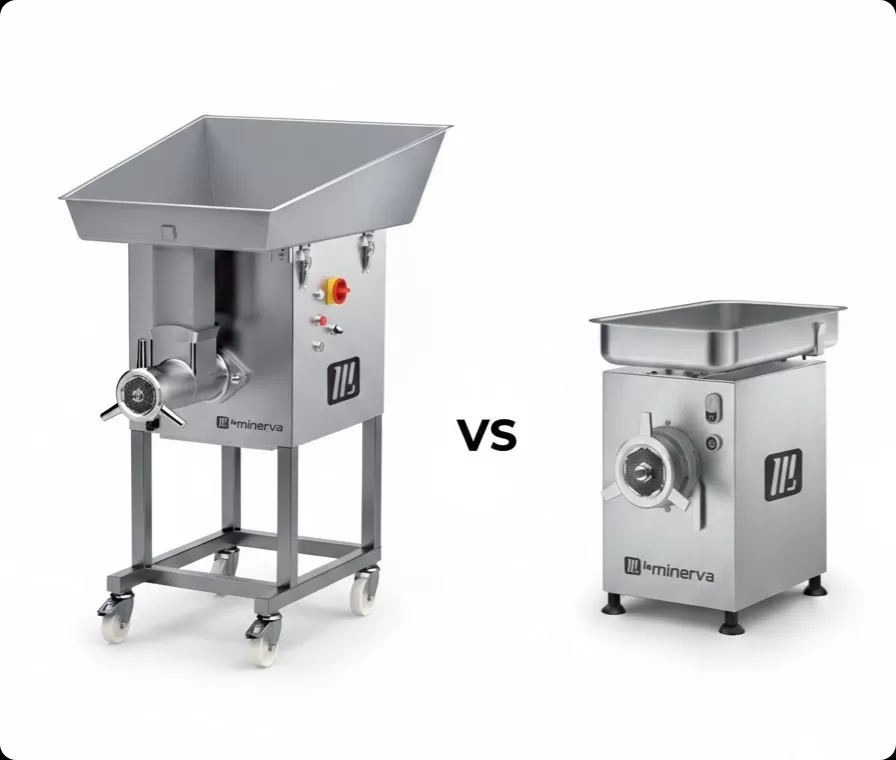
The choice of a table-top meat grinder or a floor model depends mainly on the production volumes and available space within the company, laboratory, or butcher shop.
Professional table-top meat grinders are the ideal solution for artisanal businesses and small to medium-sized businesses because they take up a smaller space and can be placed on a stable countertop, while still offering professional performance. The best table-top meat grinders feature a compact yet sturdy structure made of stainless steel, and feature pull-out hoppers of varying capacities.
Floor-standing grinders, on the other hand, are distinguished by larger dimensions and higher production capacities. These industrial meat grinders are designed to handle substantial volumes, with hoppers that can reach up to 100-150 liters of capacity and a self-supporting structure that ensures stability even during the most intensive processing phases. Floor machines are the best choice for large-scale retail trade, large meat processing and processing laboratories, as well as businesses that need to produce minced meat in large quantities.
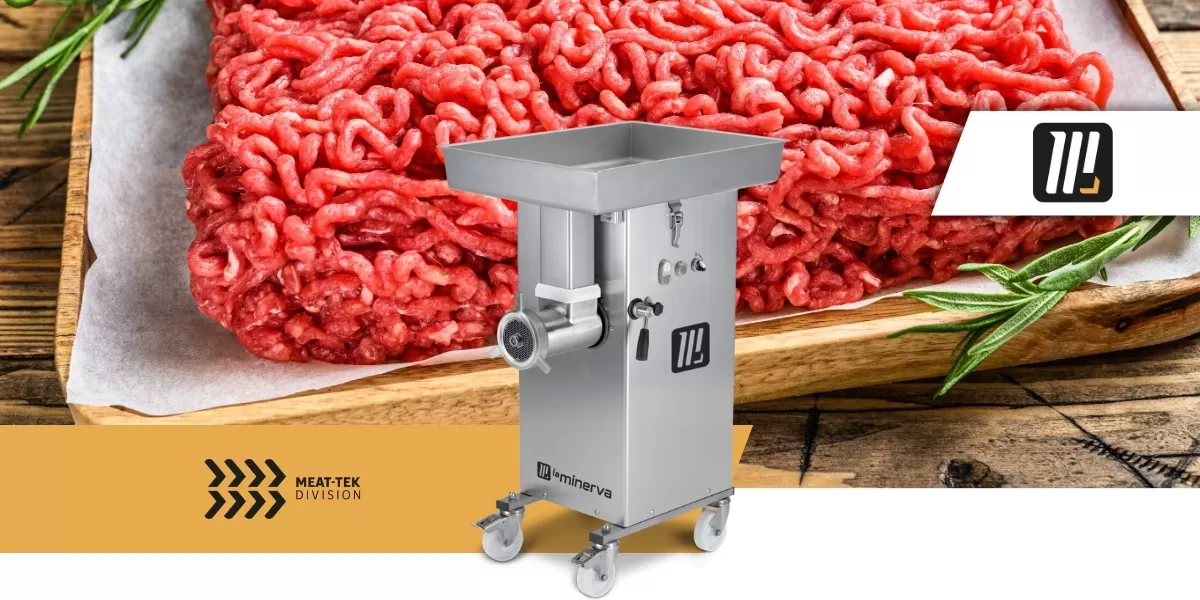
Minerva Omega Group commercial and industrial meat grinders are designed to ensure high performance, reliability over time and business continuity in every meat processing context. The design is oriented towards structural robustness, the use of high-quality materials, and the creation of technical solutions designed to ensure maximum safety, hygiene, and waste reduction. Cutting systems, available in Enterprise or Unger configurations, use self-sharpening plates and knives that ensure a uniform grind. All models are designed to facilitate cleaning and sanitization operations, with smooth surfaces, intuitive controls equipped with running, stopping and reversing functions and, in some cases, with removable hoppers.
Our range of meat grinders includes several models, designed to meet every production need. Table-top meat grinders are compact yet powerful solutions, ideal for butcher shops, delis, retail outlets, and large-scale retail outlets that require reliable performance even in space-constrained environments. Floor-standing meat grinders, designed for large volumes and continuous cycles, offer greater stability, ergonomics and power, making them particularly suitable for professional laboratories and meat processing companies.
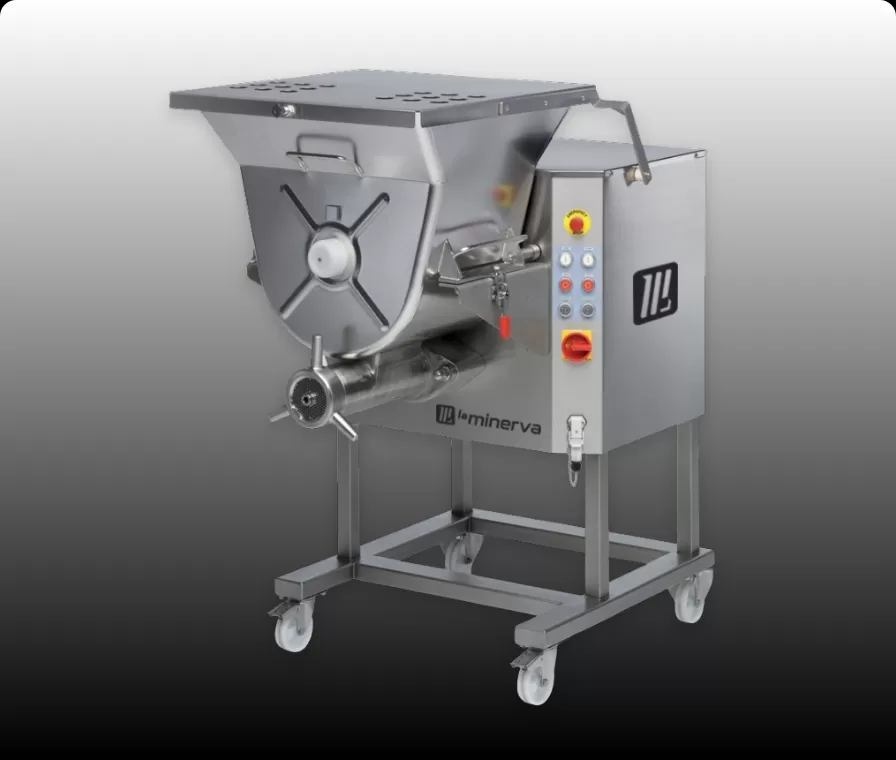
These are complemented by refrigerated meat grinders, both table-top and floor-standing, which integrate cooling systems on the hopper and conveyor to keep the meat at a controlled temperature during processing, improving hygiene, reducing waste and ensuring consistent quality of the final product. Completing the offering are meat grinders with feeder, designed to increase productivity and safety thanks to continuous and controlled feeding, reducing manual intervention and optimizing workflows in medium-high and industrial production.
Among the various models available are solutions designed to respond to specific operational needs. The KRIOS 32R refrigerated countertop meat grinder stands out for its perfect balance between performance and operational comfort: equipped with a next-generation motor, Enterprise cutting system and an internal stainless steel mouth with an optimized profile, it achieves a productivity of up to 750 kg/h, ensuring constant power, reliability and superior performance.
Refrigeration represents the ideal solution when high performance must be combined with rigorous temperature control: cold management via a refrigerant circuit with a coil ensures high cooling capacities on the entire hopper and at the grinding mouth. This maintains the cold chain throughout the grinding phase, ensuring hygiene, freshness and constant quality even in the most intensive work cycles.
For more intense production, the C/E 800 floor-standing mincer features a stainless steel structure, external mouth 32 and a productivity of up to 1500 kg/h, with Enterprise cutting system. Further increasing in capacity, the C/E 242X model is designed for high-intensity industrial machining, with productivity reaching 1700 kg/h, high power (5.2 Kw/7.0 HP engine) and maximum operational stability.
The C/E 900 floor-standing meat grinder with feeder is a professional high-performance machine, designed to ensure operational continuity and consistent results in high-volume processing. Available in Enterprise and Unger S5 versions, it features a 32 stainless steel external mouth and ensures a productivity of up to 1500 kg/h, ideal for medium and large laboratories and processing departments. The structure is entirely made of stainless steel, with a removable hopper and electrical provision for foot control. It is complete with forward, stop and reverse controls, as well as the protective device “SAFE” integrated into the mouth, for safe use and compliant with professional standards. It stands out for its solid construction and reliability over time, making it ideal for butchery workshops and structured food industries.
Want to find the meat grinder that best suits your business needs? Contact us for personalized technical advice and discover the ideal professional solution to optimize your manufacturing processes!