10 Apr 2026

Gravity vs vertical meat slicer: which to choose for your business

Professional meat slicers for butcher shops, deli counters, restaurants and large-scale retail: a technical comparison

Gravity vs vertical meat slicer: which to choose for your business
Would you like more information?

Contact us to schedule an appointment with our experts

Contact us

Choosing the right commercial meat slicer is essential to ensure cutting quality, service speed and operational safety. In butcheries, deli counters, large-scale retail and, in general, in all food processing sectors, every detail of the slicing process can directly impact the productivity and quality of the final product. For this reason, it is important to understand the technical and functional differences between the main models available on the market: manual or semi-automatic gravity slicers and vertical slicers.

Both types are designed for professional use but meet very different needs in terms of production volumes, available space and product variety to be sliced. Added to these are other important factors to consider before purchasing: frequency of use, motor power, cutting characteristics (thickness, capacity), ease of cleaning and sanitization, as well as the balance between initial investment and expected productivity over time. Carefully evaluating these aspects is the starting point for an informed choice that enhances product quality.

Let’s take a detailed look at the construction and application features of gravity and vertical slicers, comparing their performance and contexts of use, to help you identify the best professional slicer for your operational needs. 

Vertical meat slicer: features and operation

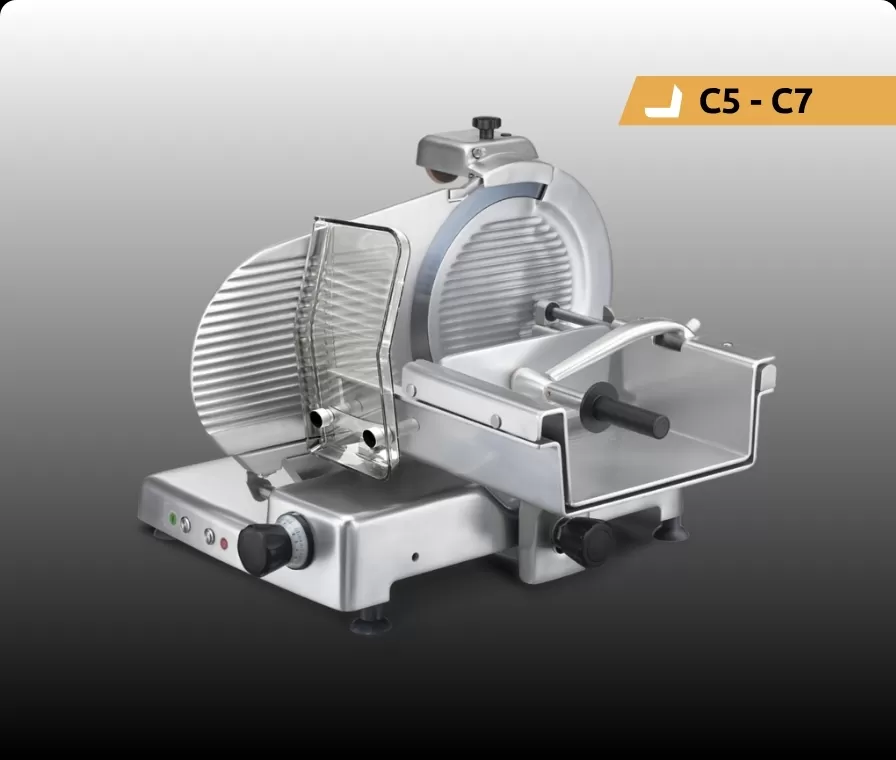
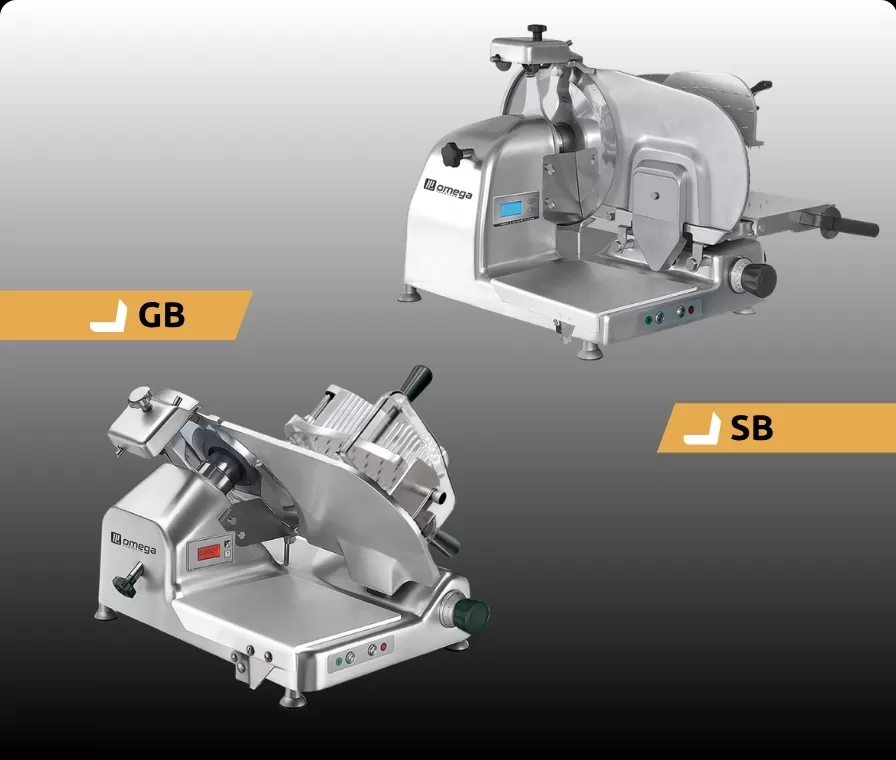
In a vertical slicer, the blade is perpendicular to the work surface. The product support features two carriages, one of which moves back and forth, with specific configurations for fresh meat and cured meats. These characteristics ensure maximum product stability during slicing: the product holder keeps the item firmly in place, allowing full control even when cutting large cuts of meat or foods with irregular shapes or particularly delicate textures.

The result is a clean, uniform and precise cut, delivering slices of constant thickness and a visual quality that reflects the care taken during slicing. Vertical slicers are the ideal solution for butcher shops handling fresh meat, as well as for large-scale retail, food laboratories and delicatessens where whole hams and large cured meats are processed - environments in which slice presentation and attention to detail are essential.

Ergonomics is another major advantage of vertical slicers: the working posture is natural and comfortable, with excellent visibility throughout operation. The ergonomic design supports prolonged use, reducing operator fatigue and improving overall slicing precision, ultimately enhancing the quality of the final result.

Gravity vs vertical meat slicer: which to choose for your business

Gravity slicer: how it works and when to choose it

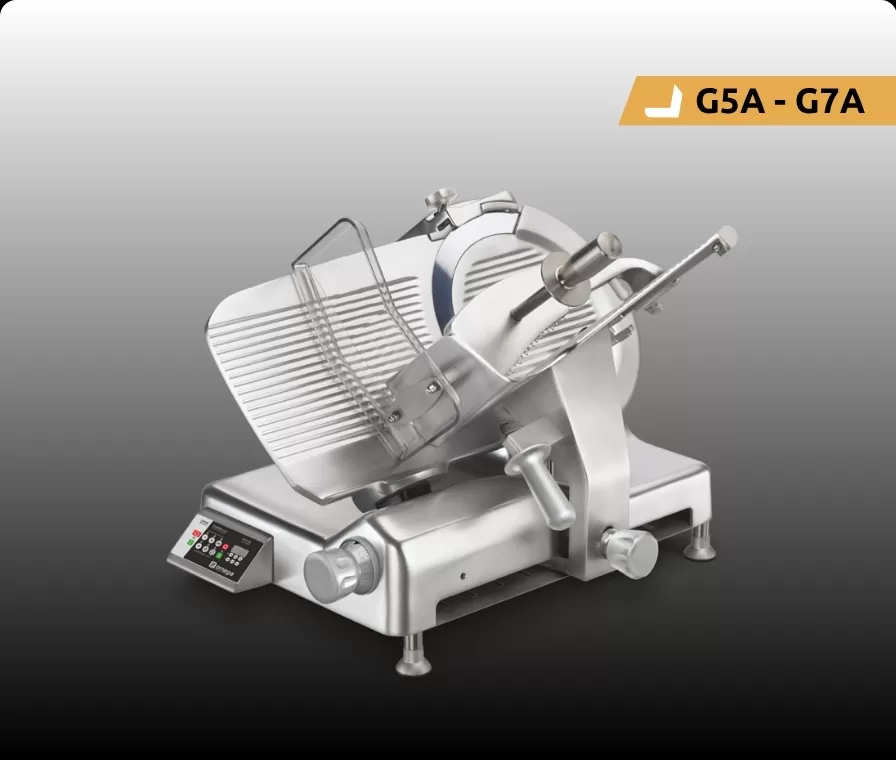
Widely used in the food processing industry, gravity slicers are valued for their ease of use, speed, and versatility across a wide range of applications. Featuring an inclined blade and an angled product carriage, it harnesses the product’s own weight to facilitate smooth, consistent movement towards the blade. The result is a fast, precise cut with minimal manual effort.

For these reasons gravity slicers are found in a variety of professional settings - from bars, pizzerias and deli counters to restaurant kitchens, catering facilities and medium-scale food production environments. They are particularly well suited to the fast-paced demands of daily service, where efficiency and ease of use are just as critical as cutting quality.

There are two main types of gravity slicer machines, each with distinct characteristics and applications:

  • Manual gravity slicers are the ideal solution for those seeking versatility and speed. They allow a wide range of meats and food products to be processed on a single machine. This flexibility makes them particularly well suited to professional kitchens, canteens, and deli counters - environments where fast service, product variety and ease of use are essential. Their compact design is an added advantage, taking up minimal workspace and integrating easily even into smaller operating areas.
  • Semi-automatic gravity slicers are the next step up from manual models, designed for operations that handle higher volumes and require greater consistency. Equipped with a motorized carriage, they automate the product-to-blade feed, significantly reducing the need for manual intervention. This results in increased productivity, perfectly uniform slices—both in weight and thickness—and reduced operator fatigue. Adjustable speed control allows the machine to adapt to both small and large products without interrupting workflow. For large-scale food production and professional catering - where efficiency, high output, and portion consistency are critical - the semi-automatic gravity slicer is the most efficient and reliable solution.

Gravity vs vertical slicer: key factors to choose the right model

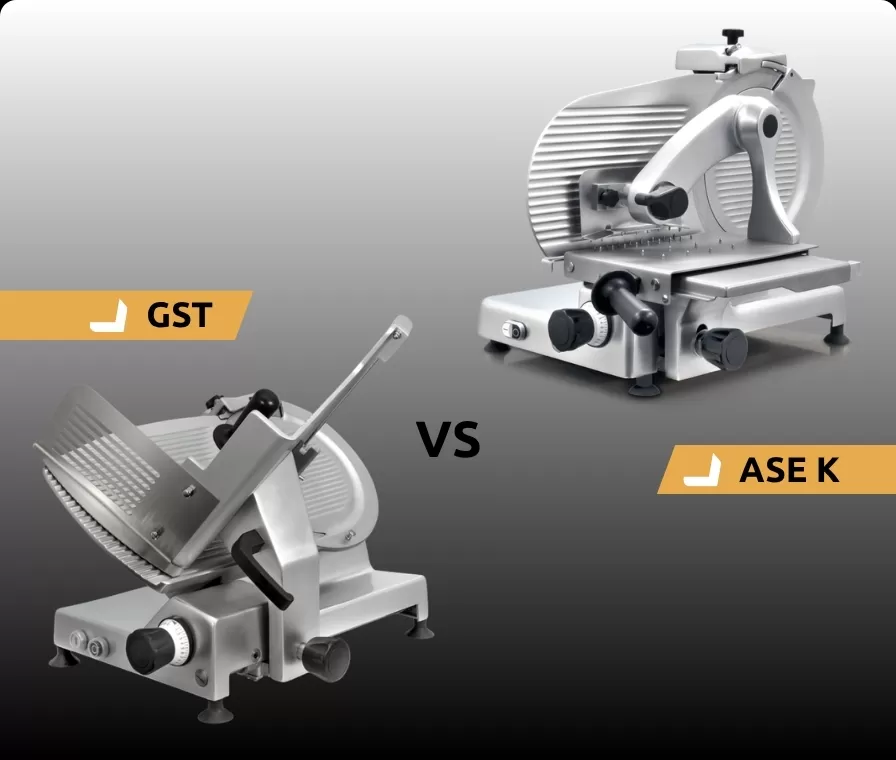
There is no universally “better” option between a gravity slicer and a vertical slicer - the right choice ultimately depends on your specific needs and how the machine will be used. The decision should begin with a clear understanding of the daily operating environment, as a well-informed purchase will directly impact service quality and overall satisfaction for both the operator and the end customer.


Here are the key factors to consider when choosing the right commercial slicer for your needs:


  • Type of use: this is the most important factor. For high-volume slicing with continuous operation, a semi-automatic gravity slicer is the ideal solution, thanks to its motorised carriage and ability to maintain a consistent cutting cycle over extended periods. For medium volumes or less frequent use, a manual gravity or vertical slicer can still deliver excellent performance while ensuring optimal results.
  • Product type and size: as mentioned, not all slicers are equally suited to every product. A vertical slicer is ideal for fresh meats, whole cured hams and large cuts, where the stability provided by the sliding plate and locking system is essential for achieving precise, uniform slices. A gravity slicer, on the other hand, offers greater versatility and can easily handle a wide variety of products, including cooked meats, cheese, roasts, and bread.
  • Cutting precision and consistency: in environments where cutting quality is essential - such as butcher shops, delicatessens or specialised sections within large-scale retail - the vertical slicer is the ideal choice. It offers full control over the slicing process, ensuring consistently precise, even slices while preserving the integrity of the product, including premium cuts. On the other hand, when speed is more important than absolute precision, a gravity slicer is the more suitable option.
  • Available space and countertop footprint: manual gravity slicers are typically more compact and easier to fit into smaller workspaces. Vertical slicers also tend to have a relatively small footprint, but they require a more careful assessment of the available space.
  • Ease of cleaning and sanitisation: in any professional food setting, equipment must be quick and easy to clean and sanitise on a daily basis. Regardless of the type, professional slicers are designed with smooth, hygienic surfaces, free from dirt traps, and feature easily removable components as well as easy access behind the blade. It is important to evaluate this aspect during the purchasing phase, as ease of cleaning has a direct impact on daily efficiency and compliance with current hygiene and safety regulations.
  • Safety: operational safety is critical in any working environment. Professional slicers are equipped with mechanical safety features - such as interlocking systems that allow the carriage to be removed only when the thickness gauge plate is fully closed - as well as electrical protections such as NVR. Ensuring compliance with current EC safety regulations on workplace equipment safety is a crucial step in the purchasing process, regardless of the type selected.

Precision, safety, quality: Minerva Omega Group professional meat slicers

Minerva Omega Group offers a complete range of commercial meat slicers designed to deliver cutting precision, long-term reliability and maximum operational safety across all areas of the food industry. Each model combines robust construction, high-quality materials and advanced technical solutions to ensure consistent performance and precise results, even under intensive use. Every machine is engineered to support the operator’s daily operations, enhancing ergonomics, simplifying cleaning, and ensuring full control over the product at every stage of processing.


To meet the needs of professionals across different sectors, production volumes and operating environments, the Minerva Omega Group range includes six professional slicer lines, each with its own distinctive features:

Gravity vs vertical meat slicer: which to choose for your business

  • Core Line: entry-level solutions designed for retail environments and small restaurants. A smart, cost-effective choice for those seeking functional technology with an accessible approach, without compromising on professionalism or final product quality.
  • Flex Line: a range of slicers designed with a performance-oriented approach. These models stand out for their smart ergonomics and ensure uniform, precise and effortless slicing, even when handling larger products.
  • Lean Line: designed with state-of-the-art construction solutions that enhance everyday usability and hygiene. Ideal for environments where quick and effective sanitisation is essential, these models feature a compact design with recessed feet to optimise space saving.
  • Gear Line: this range includes gear driven models, to ensure constant power even under the most demanding operating conditions. It is the ideal choice for professionals who require seamless and reliable performance during processing.
  • Maestro Line: refined design, advanced, safe and ergonomic user experience. They provide precise, delicate cuts that preserve the product’s organoleptic properties. The latest-generation motor maintains constant torque, reducing effort even when slicing more challenging products, ensuring maximum efficiency and lower energy consumption. Models with integrated scales, such as the GB5 and GB7, offer even greater accuracy and streamline workflow.
  • Dynamic Line: designed for those seeking high performance combined with a strong focus on operator well-being, this line includes semi-automatic gravity slicers built to maximise productivity and optimise workflow. Features such as the built-in slice counter and the setting of slice number are particularly useful for operations involving portioned products, such as ready meals, trays and platters.

Minerva Omega Group gravity slicer machines deliver outstanding reliability, even during prolonged use, ensuring smooth slicing of products with different shapes and textures. They are designed for professionals working in fast-paced environments who need a versatile, intuitive machine that is ready to use and capable of handling every request at the counter with consistent efficiency. Semi-automatic gravity slicers take performance a step further by integrating blade and carriage motors, increasing production capacity, standardising portions, and reducing operator effort. They are particularly suited to those seeking both high performance and ease of use, particularly in and large-scale catering and food production environments.


Vertical slicers stand out for their precision engineering and cutting stability, delivering impeccable results even with the most demanding products. Ideal for butchers, delicatessens, restaurants, grocery stores and specialised large-scale retail, they combine robust construction with advanced cutting technology, ensuring consistent slice quality and precise results.

Gravity vs vertical meat slicer: which to choose for your business

FAQ – Frequently asked questions about commercial meat slicers


Which meat slicer is best suited for a professional butcher?


In a butcher’s shop, a vertical slicer is generally the best choice. Its specially designed meat carriage allows for precise processing of all types of fresh meat, ensuring consistent thickness and excellent visual quality, even with larger or irregularly shaped cuts. The natural working posture and clear, continuous visibility during operation are additional advantages, especially for professionals who use the machine for extended periods.


Which slicer should you choose for a deli counter in large-scale retail?


The right choice depends on the specific operational needs. For service counters handling a variety of products at a fast pace, a manual gravity slicer offers the flexibility required. In supermarket preparation areas, however, a semi-automatic gravity slicer is often more suitable, as it ensures higher productivity, consistent slice weight and reduced operator effort thanks to the motorised carriage. Vertical slicers, on the other hand, stand out for the superior quality of the finished product, particularly when working with cured meats. In both settings, models with integrated scales provide a significant operational advantage: they allow operators to monitor slice weight directly on the machine, without interrupting the workflow, resulting in faster service and reduced waste.


Can a gravity slicer machine be used to slice fresh meat?


Yes, a gravity slicer can be used to slice fresh meat, but it is not the ideal option. Gravity slicers are primarily designed for cured meats, cooked products and cheese. When it comes to fresh meat - especially larger or whole cuts - a vertical slicer is the more suitable choice.


What is the most suitable slicer for a delicatessen or gourmet deli counter?


For deli or artisan food deli counters, where a wide variety of products is handled and speed of service is essential, a manual gravity slicer is often the best solution. It is compact, versatile, and intuitive, allowing operators to switch quickly between different products. For higher volumes and improved portion consistency, a semi-automatic model may be worth considering. Those who prioritise maximum cutting precision will find the vertical slicer to be the ideal option.


Why is an easy-to-clean design crucial in a professional meat slicer?


Often underestimated during the purchasing phase, this factor is crucial in everyday use. A professional slicer needs to be sanitised several times a day, and a machine that is difficult to clean can significantly increase maintenance time. Selecting models with easily removable components and user-friendly cleaning features is essential to ensure full compliance with current hygiene and sanitation standards. 


Which meat slicer is best for a food lab?


The ideal choice depends on production volume and the required level of standardization. A manual gravity slicer is suitable for smaller labs handling a variety of products, while higher volumes requiring consistent portioning call for a semi-automatic gravity slicer. For labs specializing in fresh or premium cured meats, a vertical slicer is best, ensuring both quality and precision.


What is the difference between an automatic and a semi-automatic slicer?


In a semi-automatic slicer, both the carriage movement and blade rotation are motorised, but the operator still plays an active role in certain stages of the process, such as positioning the product and supervising the cutting cycle. For those who require precise portion control, semi-automatic models with integrated scales provide an added advantage: weighing takes place directly on the machine during slicing, eliminating the need for additional handling and ensuring greater accuracy.


Conversely, automatic slicers operate independently, featuring integrated feeding, slicing, and unloading systems that ensure fully autonomous, low-intervention operation. Despite this, semi-automatic slicers remain the preferred choice in professional catering and food processing labs, where a balance of control, flexibility, and performance is essential

 Looking for the best professional meat slicer for your businessContact us for a personalised technical consultation and discover the solution that best fits your operational needs.